← Back to Youssef ahmed elmghawry's portfolio
Chemistry & Pharmaceutical Analysis
Caffeine : Structural & Spectral Analysis
A project by Youssef ahmed elmghawry — Pharmacy · Product Designer · Project Manager
Case study
What it revealed
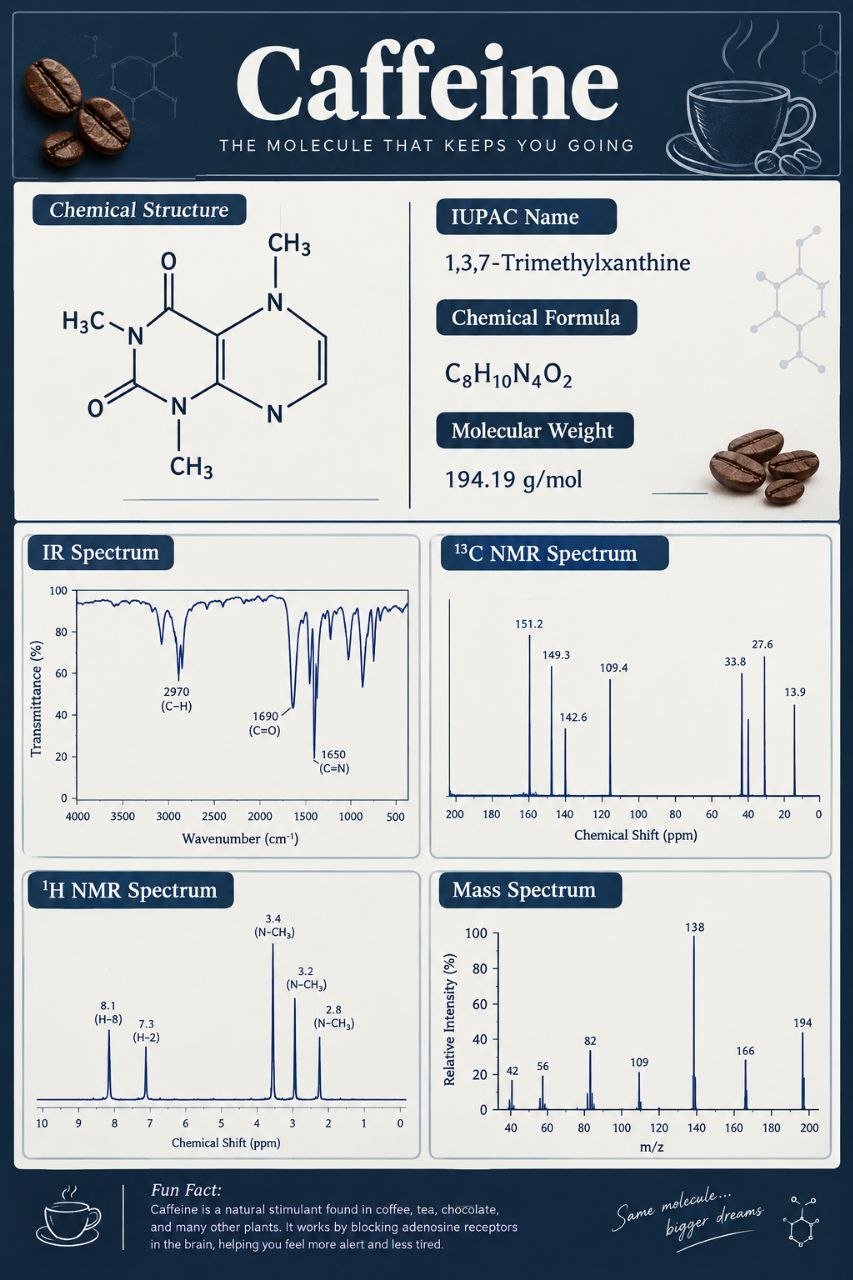
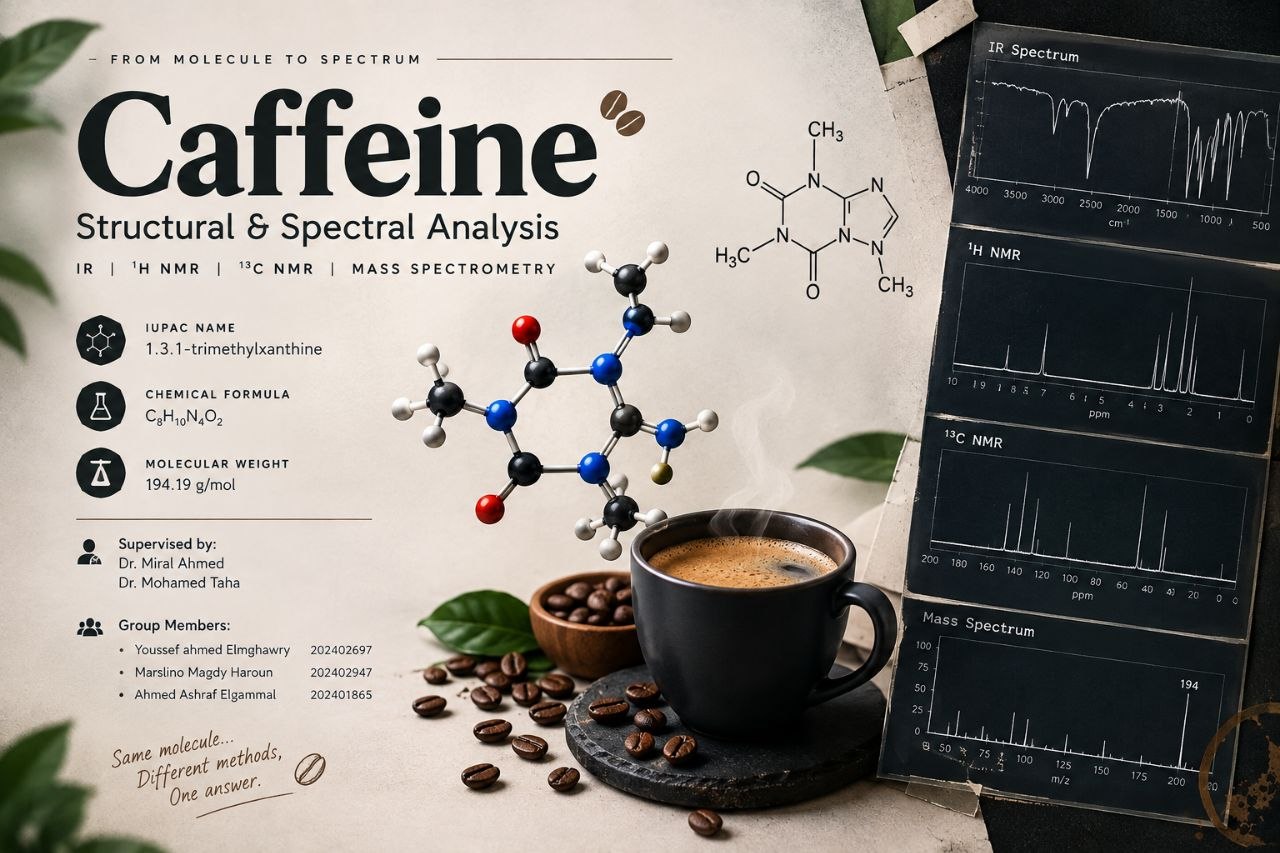
- 1. General Information - IUPAC Name: 1,3,7-Trimethylpurine-2,6-dione - Chemical Formula: C8H10N4O2 - Molecular Weight: 194.19 g/mol Caffeine is a natural stimulant found in coffee, tea, and chocolate. It helps increase alertness and reduce tiredness.
- 2. Chemical Structure Caffeine is a heterocyclic compound containing four nitrogen atoms, two carbonyl groups, and three methyl groups.
- 3. IR Spectrum IR spectroscopy identifies functional groups in caffeine. - Around 2950–3000 cm-1: C-H stretching. - Around 1650–1700 cm-1: C=O stretching. - Around 1500–1600 cm-1: Ring vibrations. These absorption bands help identify the functional groups in caffeine.
- 4. 13C NMR Spectrum Carbon-13 NMR identifies different carbon environments. - Around 150–155 ppm: Carbonyl and ring carbons. - Around 105–150 ppm: Other ring carbons. - Around 25–35 ppm: Methyl carbons.
- 5. 1H NMR Spectrum Proton NMR identifies different hydrogen environments. - Around 7.5–8.0 ppm: One ring proton. - Around 3.2–4.0 ppm: Hydrogen atoms of the three N-CH3 groups.
- 6. Mass Spectrum Mass spectrometry determines molecular mass and fragmentation. - m/z 194: Molecular ion. - m/z 166: Fragment ion. - m/z 138: Major fragment ion. - m/z 109 and 82: Smaller fragment ions. These peaks help confirm the molecular mass and structure of caffeine.
- 7. Fun Fact Caffeine blocks adenosine receptors in the brain, helping people feel more awake and alert.
Figures